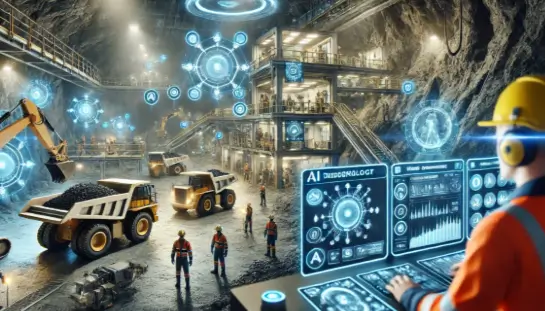

Artificial intelligence in mining enables safer, more efficient operations through real-time sensing, predictive analytics, and autonomous systems. AI-driven safety monitoring provides rapid alerts and auditable decisions, while predictive maintenance analyzes vibration and temperature data to extend asset life and reduce downtime. Integrated digital twins and data fusion support adaptive sampling, grade estimation, and optimized blasting and scheduling. This data-driven approach raises questions about risk, accountability, and continued performance improvements that warrant further examination.
How AI Improves Safety and Risk Management
The integration of artificial intelligence into mining safety and risk management enhances decision-making by enabling rapid, data-driven assessments of evolving conditions.
AI-driven safety culture emerges as teams leverage real-time alerts and standardized responses, reducing ambiguity.
Hazard forecasting improves proactive measures, guiding resource allocation and training.
Decisions become auditable, performance trends measurable, and safety objectives align with operational freedom and accountability.
Predictive Maintenance: Reducing Downtime and Costs
Predictive maintenance leverages AI-driven analytics to anticipate equipment failures before they occur, cutting unplanned downtime and extending asset life.
In mining operations, continuous monitoring gathers vibration, temperature, and usage data to forecast wear patterns.
This enables scheduled interventions, reduces spare-part costs, and improves uptime.
The approach supports cost reduction through optimized maintenance cycles and informed asset deployment decisions.
See also: postnewstoday
Optimizing Operations: Blasting, Scheduling, and Autonomous Systems
Optimizing operations in mining integrates blasting design, production scheduling, and autonomous systems to maximize fragmentation, grade control, and throughput. AI-driven blasting optimization informs fragmentation analysis, while autonomous scheduling aligns fleet coordination with sensing and analytics for real time condition monitoring. Digital twin integration supports ore grade estimation, enabling informed decisions. This approach enhances efficiency, safety, and overall mine performance through precise, data-driven control.
Real-Time Sensing and Ore Grade Estimation With Digital Twins
Real-time sensing and ore grade estimation integrate sensor data, analytics, and digital twin models to provide up-to-the-second visibility into rock and ore characteristics.
Data fusion enables consolidated insights from multiple streams, while anomaly detection flags deviations from normal spectra.
Digital twins simulate ore bodies for adaptive sampling, calibration, and risk assessment, supporting autonomous decision making and transparent, data-driven mining operations.
Frequently Asked Questions
How Does AI Impact Worker Retraining and Job Displacement in Mining?
AI workforce impacts include modest job displacement as automation shifts tasks; miners retraining through reskilling programs enhances adaptability, while data-driven assessments guide AI adoption. Employers expand protections, and ongoing miners retraining ensures resilient, freedom-centered transitions amid evolving roles.
What Are Ethical Considerations for AI Data Use in Mining Communities?
Ethical considerations for AI data use in mining communities center on AI governance, data ownership, and transparent consent mechanisms; tensions between efficiency and rights must be managed through accountable policies, equitable access, and continuous community-informed oversight.
How Is AI Adoption Funded and Returned on Investment Measured?
AI funding and ROI metrics drive decisions, but satire aside, investors seek clear milestones: upfront capital, cost savings, safety gains, and sustainability tracking. Workforce impact, retraining, ethics, data governance, water efficiency, regulatory compliance, and governance shape ROI timelines. Funding models, ROI metrics
Can AI Reduce Water Usage Beyond Current Efficiency Targets?
AI efficiency suggests marginal to meaningful reductions in water usage beyond targets, aided by enhanced forecasting and process optimization; water stewardship programs amplify gains. AI efficiency, water stewardship, AI efficiency, water stewardship are supported by robust metrics and transparent reporting.
How Do Regulatory Frameworks Shape AI Deployment in Mining?
Ironically, regulatory frameworks shape AI deployment in mining by mandating robust regulatory compliance and strict data governance, ensuring risk controls and transparency; they guide standards, certify algorithms, and constrain experimentation, while empowering independent innovation and data-driven operational freedom.
Conclusion
Artificial intelligence enhances mining by strengthening safety, reliability, and productivity through real-time sensing, predictive analytics, and autonomous systems. Data-driven insights enable rapid risk assessment, proactive maintenance, and optimized operations, from blasting to scheduling and ore grade estimation with digital twins. As operations scale, AI reduces downtime and material waste while boosting asset longevity and compliance. The industry’s trajectory echoes an old adage: measure twice, cut once—ensuring decisions are precise, auditable, and value-driven.