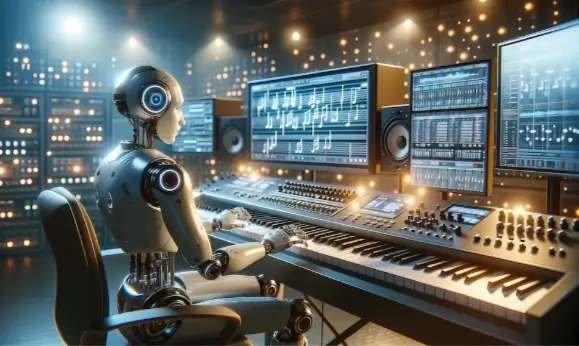

Artificial intelligence in music creation analyzes patterns in harmony, rhythm, and timbre to propose viable ideas while preserving authorial intent. Generative models assist ideation, iterative refinement, and exploratory composition, guiding purposeful experimentation. Practical pipelines emphasize reproducible training, transparent data provenance, and efficient real-time inference. Writers and producers balance automation with control, addressing licensing, attribution, and ethics to maintain provenance and ownership. The result is a workflow that accelerates idea generation and perceptual refinement, leaving a question that warrants careful consideration.
What AI in Music Creation Actually Does
AI in music creation operates as a set of computational tools that augment, automate, or augment—not replace—human compositional workflows.
The discussion focuses on capabilities, not magic: pattern recognition informs harmony, rhythm, and timbre; generative models propose viable ideas while preserving authorial intent; evaluation metrics compare outputs against stylistic targets.
idea one anchors evaluation, idea two guides iterative refinement, enabling purposeful experimentation within freedom-enabled creative practice.
Tools and Tech Powering AI-Powered Composition
Tools and technology underlie AI-powered composition, translating musical intent into actionable processes that span data acquisition, model architecture, and deployment infrastructure.
The landscape hinges on data sourcing and licensing, with careful attention to AI ethics and originality.
Engineers evaluate model transparency, reproducibility, and bias, while practical pipelines emphasize reproducible training, efficient inference, and robust integration for real-time creative workflows.
See also: How Artificial Intelligence Is Used in Mining
How AI Reshapes Production, Mixing, and Mastering
How AI reshapes production, mixing, and mastering centers on delivering algorithmic efficiency and perceptual accuracy across the audio pipeline. The approach emphasizes reproducible results, streamlined sessions, and repeatable signal paths, with attention to AI ownership and model licensing. Practitioners weigh ethics, originality, and practical considerations for artists, balancing automation benefits against creative control, workflow predictability, and archival integrity.
Ethics, Originality, and Practical Considerations for Artists
Ethics, originality, and practical considerations for artists require a structured assessment of how AI-driven tools influence creative agency, intellectual property, and workflow discipline. This analysis compares ethics vs originality, highlighting tensions between machine-assisted authorship and human authorship rights. It also assesses legal implications, licensing constraints, and attribution norms, proposing disciplined workflows that safeguard ownership while embracing innovation and maintaining transparent provenance.
Frequently Asked Questions
How Do AI Composers Handle Real-Time Live Performance?
AI composers address real-time live performance by minimizing AI live latency through optimized algorithms and hardware acceleration, balancing performance constraints with robust AI improvisation. They enable real time collaboration, adapting to musicians while reducing latency and ensuring reliable responses.
Can Ai-Generated Music Evoke Human Emotion Effectively?
Emotion perception exists, AI-generated music can evoke feelings, but effectiveness hinges on calibration, data scope, and contextual cues; allegory frames it as a clockmaker tuning resonance. The result supports emotional storytelling with measurable, audience-dependent impact.
What Are Licensing and Ownership Rights for Ai-Created Works?
Licensing ownership concerns who holds rights licensing for AI-created works, often complicating authorship attribution, derivative works, and revenue. The analysis suggests clear terms—ownership vests in creators or developers, with explicit licenses, disclosure, and traceable provenance to ensure practical freedom.
How Does AI Collaborate With Human Songwriters During Sessions?
AI assists during sessions by enabling co creation workflows and real-time collaborative improvisation, where human songwriters guide prompts, judge outputs, and iterate. The process remains analytical, practical, and controlled, preserving artistic intent while amplifying creative freedom.
Will AI Replace Human Musicians in the Industry Eventually?
AI will not wholly replace human musicians; rather, it reshapes roles. The analysis emphasizes AI ethics and creative agency, recognizing augmentation and collaboration as practical, technical shifts that empower artists while preserving diverse, autonomous artistic control and freedom.
Conclusion
AI in music creation serves as a strategic accelerant rather than a substitute for artistry. It augments ideation, prototyping, and perceptual tuning while preserving authorial intent through transparent provenance and controlled pipelines. The technology’s value lies in reproducible training, clear licensing, and ethical attribution, ensuring ownership remains with humans. As tools become more capable, practitioners should treat AI as a collaborator that reveals possibilities, not a replacement—like a compass guiding an artist through uncharted sonic terrain. It points, but the composer chooses.